What it is
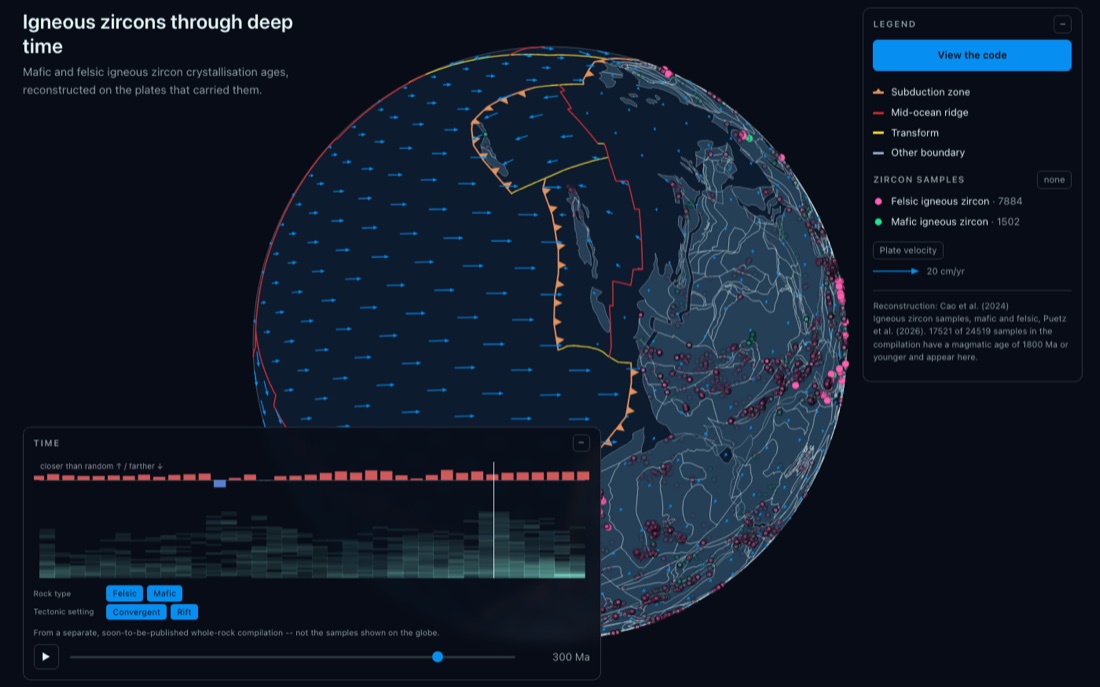
Mafic and felsic igneous zircons from Puetz et al. (2026), reconstructed on Cao et al. (2024) from 1800 Ma to the present. A sample is drawn from its crystallisation age onwards, bright for 5 Myr and faint after, so the map accumulates as you scrub.
A chart above the time slider asks whether felsic and mafic rocks sit closer to a subduction zone than chance would put them. It draws on a separate whole-rock compilation, not the samples on the globe, and says so.
The viewer was exported from one Python notebook with no hand-written JavaScript. Its "View the code" drawer carries the recipe, a generated script and the notebook.
Contents
- SamplesFelsic and mafic, 17,521 of 24,519 at 1800 Ma or younger.
- Bright and faintAge drives brightness, not visibility. A zircon does not stop existing.
- BoundariesSubduction zones, ridges and transforms, Cao et al. (2024), 0–1800 Ma at 1 Myr.
- Plate velocityArrows with a scale bar.
- Distance chartDistance to the nearest subduction zone through time, against a random baseline, by rock type and setting.
- View the codeThe recipe, a generated script and the notebook it came from.
Controls
- Drag to rotate, scroll to zoom.
- Age slider 0–1800 Ma, or press play.
- Hover a sample for its age, rock type and locality.
- Toggle rock type and tectonic setting under the chart.
Lesson sketches
Arcs and zircons
- Find three times where the bright samples are densest.
- At each, describe where they sit relative to the subduction zones.
- Read the distance chart at the same times. Are felsic rocks closer than chance, and mafic ones?
- Switch tectonic setting from convergent to rift and compare.
Is the zircon record a record of magma production, or of what survived to be sampled?
Why zircon
- Start at 1800 Ma and play forward. Watch the faint archive build.
- Point out that every faint dot is a crystal that still exists.
- Contrast with detrital zircons, where samples vanish outside their window.
What would this map look like for a mineral that weathers easily?
Source
No public repository yet.