What it is
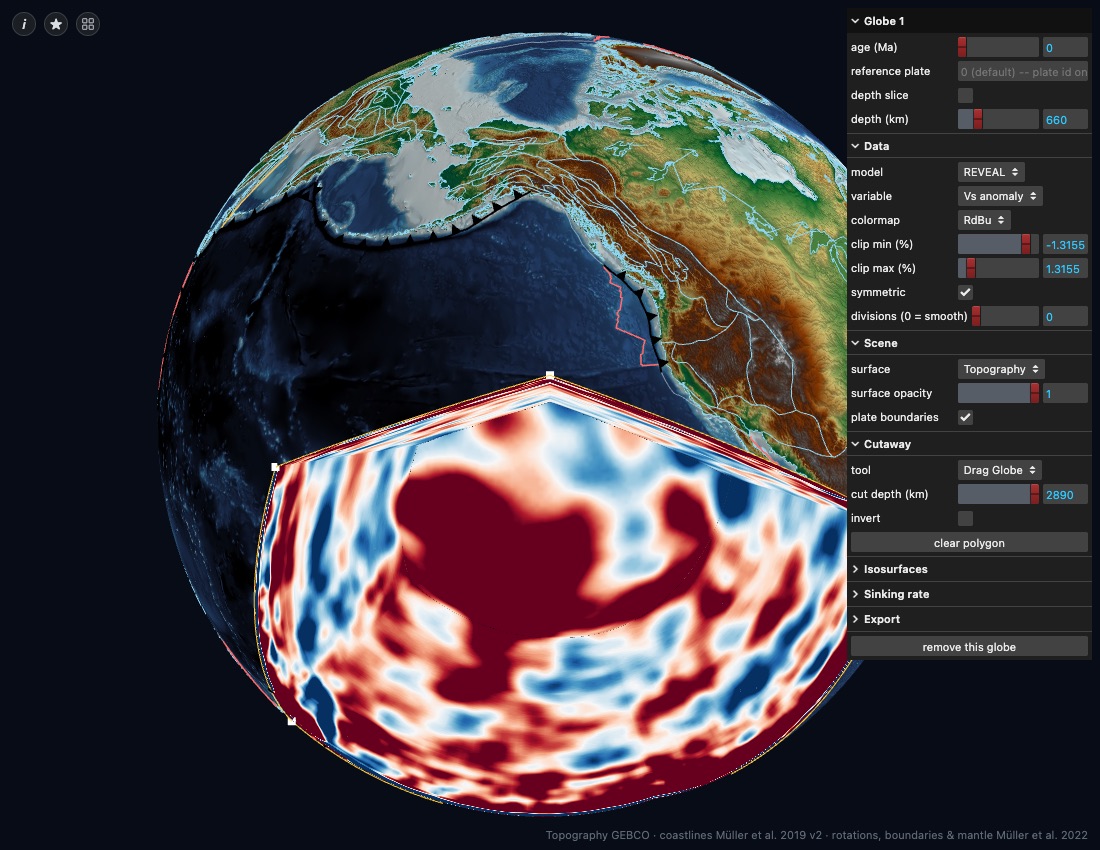
Tomography and convection models as a 3D volume. Draw a polygon on the surface and the viewer cuts the Earth away along it, texturing the exposed faces with the model itself.
Contents
- TomographyWave-speed anomalies through the whole mantle.
- ConvectionOne run, scrubbed through 200 Myr.
- CutawayClick a polygon; the volume inside goes.
- IsosurfacesFast or slow bodies contoured as solids.
- Depth sliceMovable, with depth read as sinking time.
- SurfaceReconstructed coastlines and plate boundaries.
Controls
- Drag to rotate, scroll to zoom.
- Time slider moves the surface; convection volumes follow.
- Click points on the globe to place a cut.
Lesson sketches
Find the slab, then find its trench
- Cut across the western Pacific; find a fast anomaly descending through the transition zone.
- Read its depth, convert to age at 1–2 cm/yr.
- Set the reconstruction to that age. Was there a trench above it?
- Repeat under the Americas, then under Africa.
Which steps in that chain are measurement, and which are model?
Hot and cold are not mirrors
- Isosurface at a fast threshold. Note the shapes.
- Isosurface at the matching slow threshold. Note that they are nothing alike.
- Move both thresholds and record what appears and vanishes.
How much of that asymmetry is Earth, and how much is the inversion?
What is under my feet
- Cut a wedge under the visitor's home town.
- Point out the crust, too thin to see at this scale.
- Find the nearest sheet of old seafloor and say when it went down.
If the Earth were an apple, how thick is the skin?