What it is
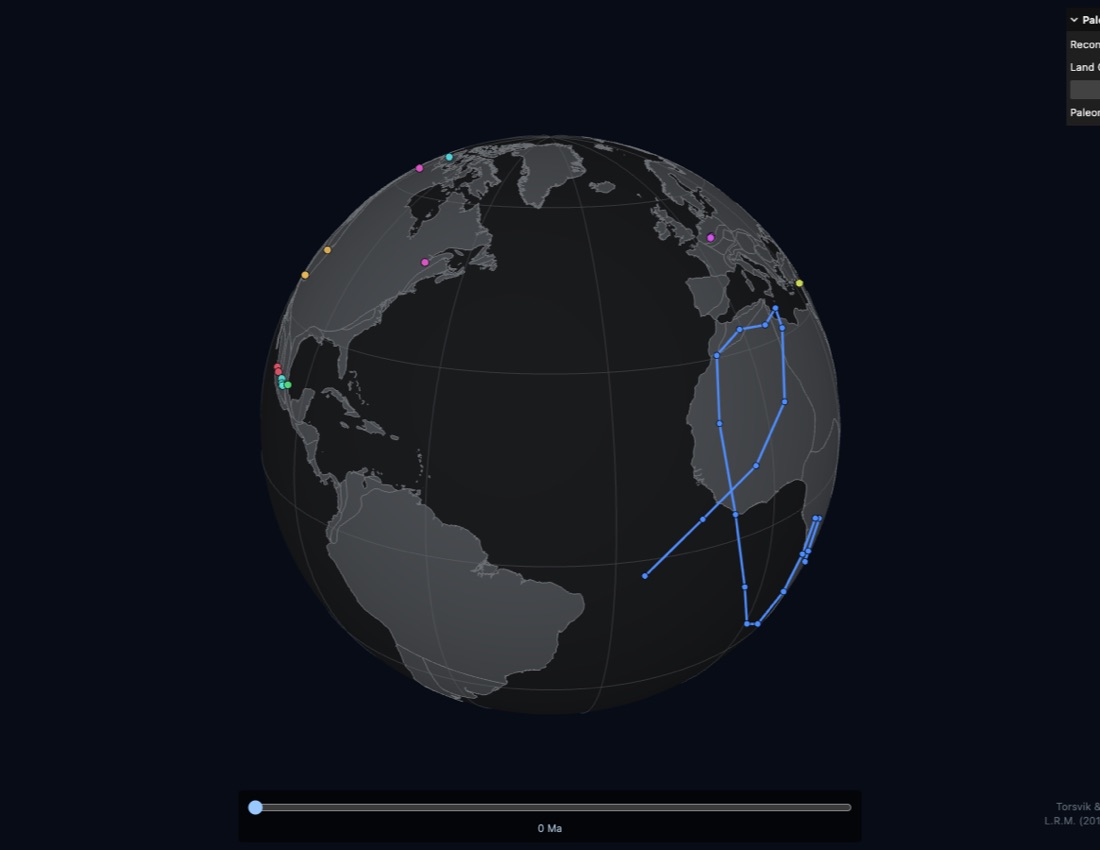
The Torsvik et al. (2012) virtual geomagnetic poles, each drawn with the outcrop it was measured at, on several Reconstruction Models side by side. If a model is right, the poles from its plates should gather at the spin axis at their own age.
Contents
- PolesVGPs within 5 Myr of the slider age, coloured by plate.
- Sample sitesThe outcrop behind each pole, carried on the same plate.
- GAPWaPThe global apparent polar wander path.
- ModelsTorsvik & Cocks 2017, Scotese and Merdith 2021.
- Land colourBy theme, by plate, or by how many poles a plate has at this age.
- Map OrientationRecentre a flat map anywhere, including on the pole.
Controls
- Drag to rotate, scroll to zoom.
- Age slider along the bottom.
- Click a pole or a site to select both and read its record.
Lesson sketches
Do the poles land on the axis?
- Pick an age with plenty of poles. Note how tightly they gather at the spin axis on each model.
- Find a plate whose poles miss. Click one and read its age, a95 and locality.
- Step 20 Myr either way and see whether the miss persists.
- Compare the same pole across models.
When a pole misses, how do you decide between a bad pole and a bad model?
Where the data are
- Set Land colour to pole count.
- Scrub through the Phanerozoic and note which plates carry the record at each age.
- Find an interval where one continent holds almost all of it.
How far can a global reconstruction be trusted on plates with no poles at that age?
Why the compass points north
- Show a pole and its sample site at 0 Ma: the pole sits at the axis.
- Move back in time and watch the continent carry the site away.
- Point out that the pole stays near the axis only because the continent was moved to put it there.
If rocks remember where north was, what else can they tell us about where they were?