What it is
Continents on a globe, free to drag. Each moves as a rigid plate on the sphere, by a rotation about an Euler pole. However many drags it takes, the table shows the single pole and angle that carries each plate from where it is today to where you left it. Press Play and the plates travel back to the present, each turning about its own pole.
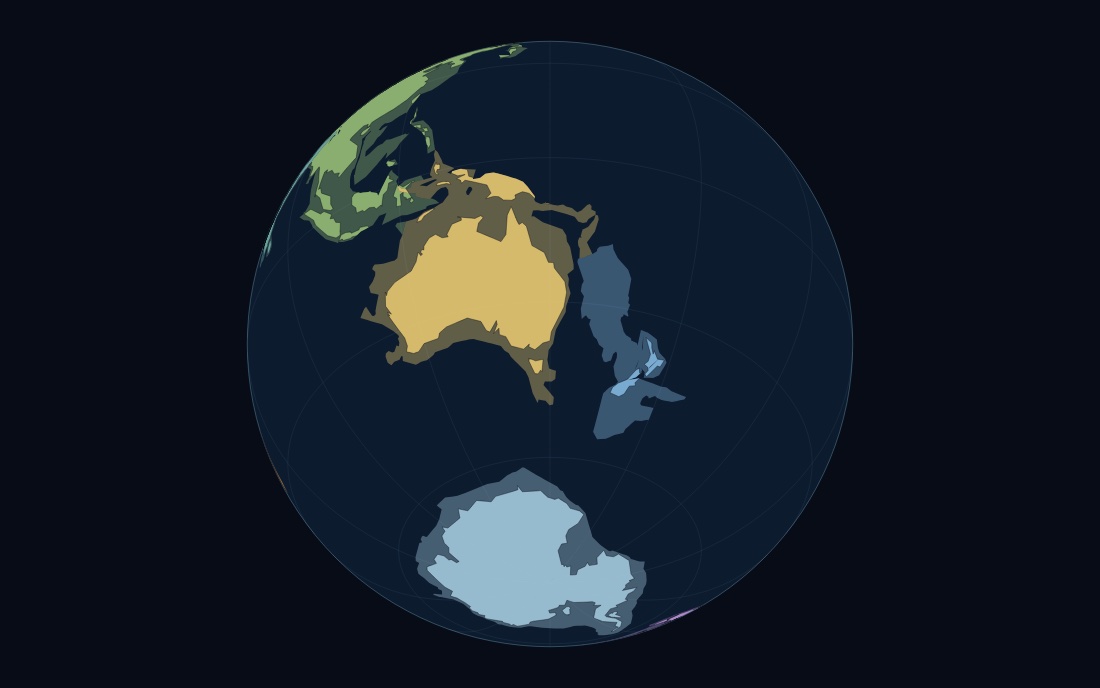
Three chapters, each asking why the last fit was not perfect: six coastlines; then India, Iberia, Madagascar, Greenland and Mexico freed as plates of their own; then the continental crust that lies under the sea, with Zealandia.
A fourth turns from fitting continents to moving them over the mantle. Africa alone starts where it is today, over fixed hotspots. Drag it to where it was 150 million years ago and each hotspot draws the trail that rotation implies, a disc every 10 Myr in the colour of its age. Line the discs up with the dated seamounts and the raised seafloor of the Tristan, St Helena, Réunion and Canary chains.
A fifth puts the two together as a rotation tree. It starts from your chapter 3 fit and your chapter 4 Africa. Click one plate, then the plate it moves with, and a line joins their centres. Link everything back to Africa, the mother plate, and moving Africa carries the whole assembly, with each plate keeping its rotation relative to its parent.
A sixth opens the South Atlantic from its seafloor. Africa stays put. Pick an isochron, from C5 at 11 Ma to M0 at 120 Ma, and the globe shows the ocean as it was then; drag South America until the two flanks of that age meet. Fit them one by one and your rotations draw synthetic flowlines, to set against the fracture zones, the path of finite poles, and the spreading rate at four places along the ridge.
Contents
- Chapters1. Fit the continents. 2. More than six. 3. Beneath the waves. 4. Plates over plumes. 5. The rotation tree. 6. Opening the South Atlantic.
- PlatesGroups of continental blocks from Müller et al. (2019), land from Natural Earth 1:110m.
- Submerged crustShelves and stretched margins, the real edge of each continent (chapter 3).
- ZealandiaLord Howe Rise, Challenger and Campbell plateaus, and New Zealand (chapter 3).
- HotspotsTristan, St Helena, Réunion and Canary: positions, dated samples and chain seafloor after Maher et al. (2015); Azores with no dated trail (chapter 4).
- MisfitMean distance from each dated sample to your predicted trail at its age, per hotspot (chapter 4).
- Rotation treeEach plate moves with another or with the mantle, linked by clicks and drawn as lines between plate centres; the .rot export is the same tree (chapter 5).
- Carried overChapter 5 starts from your chapter 3 fit and chapter 4 Africa, stored in the browser or loaded from exported .rot files.
- SeafloorSouth Atlantic fracture zones from GSFML (Wessel et al. 2015) and isochrons C5 to M0 from Seton et al. (2012) (chapter 6).
- Flowlines and ratesSynthetic flowlines from your fitted stages, a misfit to fracture zones and isochrons, finite poles, and full spreading rates at four ridge points (chapter 6).
- Euler poleEach plate's total rotation as pole latitude, longitude and angle.
- PlayFrom your reconstruction to present day and back, each plate about its own pole.
- ExportA .rot file: identity at 0 Ma, your arrangement at the reconstruction age.
Controls
- Pick a chapter from the menu.
- Drag a plate to slide it; the point you grabbed stays under the cursor.
- Shift-drag, or switch on Twist, to spin it about its own centre.
- Drag the ocean to turn the globe.
- Play, or scrub the time bar; grabbing a plate returns to the reconstruction.
- In chapter 6, pick an isochron to fit; Present shows every stage against the fracture zones.
- Undo, Reset, Export .rot.
Lesson sketches
Close the Atlantic
- In chapter 1, drag South America against West Africa until the coastlines fit.
- Bring North America against northwest Africa and Europe.
- Open chapter 2 and chapter 3 and fit them again. Note where each change helps.
- Compare your fits with a neighbour's.
Coastline, freed blocks, or submerged crust: which change improved the fit most, and why?
One rotation, however many moves
- Move Australia in three separate drags and a twist.
- Note the single pole and angle the table reports.
- Reset, and try to reach the same place in one drag.
Why can one drag not always get there, but one rotation always can?
Play it forward
- Assemble a supercontinent in chapter 3 at 200 Ma.
- Press Play and watch the plates return to the present.
- Find two plates whose paths cross or overlap on the way.
- Scrub back and forth to see when it happens.
Each plate turns steadily about one pole the whole way. Is that how continents actually moved, and what evidence would tell you?
The hidden continent
- Open chapter 3 and find Zealandia.
- Compare how much of it is land with how much is underwater.
- Drag it back against Australia and Antarctica.
If most of a continent is underwater, how would anyone know it is there?
Africa over the hotspots
- Open chapter 4 and drag Africa until the trail discs run along the Tristan and St Helena chains, colour for colour.
- Watch the misfit box: bring the total down, then check Réunion and Canary.
- Press Play to watch the trails being laid down.
Can one rotation from 150 Ma fit all four chains? Where does it fail, and what would you need to fix it?
Build the tree
- Finish chapters 3 and 4, then open chapter 5: your fit and your Africa are already there.
- Switch on Link plates and link every plate back to Africa.
- Move Africa and watch the assembly follow; check the hotspot misfit.
- Relink North America from Eurasia to Africa and press Play again.
The plates end in the same place with either tree, but not by the same path. Which tree is right, and what would tell you?